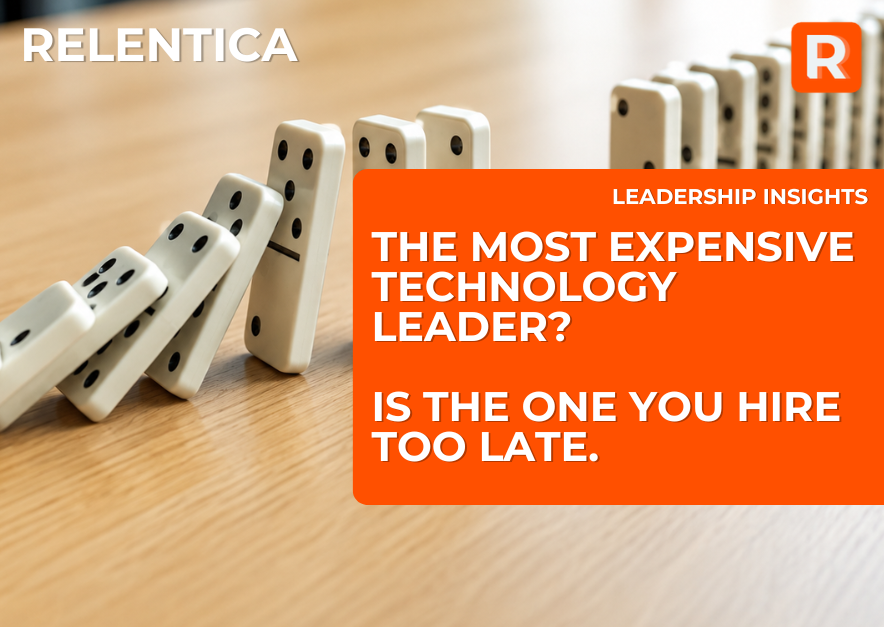
Waiting feels safe. It rarely creates value.
Every leadership team understands the cost of making a bad decision. Far fewer understand the cost of making no decision at all. The most expensive leadership decision is often the one that feels the safest – waiting. Waiting for the budget to improve. Waiting until the business is bigger. Waiting until after the acquisition. Waiting until the ERP programme starts. Waiting until AI becomes clearer. Waiting until the perfect permanent hire arrives. Every delay feels rational in isolation. Together, they quietly become one of the biggest barriers to growth.
The problem is that delay rarely appears as a line on the profit and loss statement. There is no invoice labelled “opportunity cost” and no monthly report highlighting the value that could have been created if decisions had been made earlier. Instead, organisations simply become accustomed to moving more slowly than they should. Projects take longer, opportunities are missed, leadership teams become increasingly operational and the organisation accepts a level of performance that gradually becomes the norm.
That is why the question should never be, “When do we need a Fractional CIO?”
The better question is, “How much value are we already losing by waiting?”
Delay feels low risk. It usually isn’t.
Businesses often convince themselves that waiting is the prudent option. Recruiting permanently feels like a significant commitment, particularly in uncertain markets. Boards understandably want confidence before making executive appointments, while CEOs and CFOs balance investment decisions against competing priorities. On paper, delaying the decision appears to reduce cost and preserve flexibility.
The commercial reality is often the opposite.
Every month without the right leadership allows uncertainty to grow. Strategic decisions are pushed into the next steering meeting. Technology teams continue delivering today’s priorities without anyone creating tomorrow’s direction. AI initiatives remain isolated experiments because nobody is accountable for turning them into business capability. Data quality issues continue to frustrate reporting, while operational inefficiencies become accepted simply because nobody has the capacity or experience to challenge them.
None of these problems are dramatic enough to trigger immediate action. That is precisely why they become expensive. They slowly reduce growth, erode margin and increase operational risk, often long before anyone recognises the commercial impact.
Waiting does not eliminate risk.
It simply changes where the organisation pays for it.
Business change is the trigger, not technology
One of the biggest misconceptions about executive technology leadership is that it should only be introduced when there is a technology problem to solve. In reality, the trigger is almost always commercial change.
An acquisition needs integrating before momentum is lost and anticipated synergies disappear. A major ERP or CRM programme requires experienced leadership to keep commercial outcomes ahead of technical complexity. AI has moved beyond experimentation, but the organisation lacks the operating model, governance and leadership to embed it successfully. A growing business has outpaced the capability of its existing leadership team, or perhaps an experienced executive has left at exactly the point the organisation can least afford uncertainty.
These situations have very little to do with technology itself. They are moments where leadership capability directly influences business performance. The technology is simply one of the levers that enables the organisation to move faster, make better decisions and execute with greater confidence.
The same applies to organisations preparing for investment, refinancing or exit. Experienced leadership is often brought in to strengthen governance, simplify operating models, improve reporting, reduce technology risk and create greater confidence for investors. Those activities are not technical exercises. They are commercial investments designed to protect and increase enterprise value.
The organisations that create the most value recognise these moments earlier than everyone else. They do not wait for problems to become visible before acting. They understand that leadership capability is an investment in execution, not another layer of management.
And that changes the conversation completely.
Experience should scale with the business
One of the biggest misunderstandings surrounding fractional and interim leadership is that organisations see it as a temporary replacement for a permanent executive. In reality, the best organisations use it very differently. They use it to bring proven experience into the business at exactly the moment it creates the greatest commercial return.
That changes the entire conversation. Instead of asking whether the organisation is large enough to justify a full-time CIO or CTO, the better question becomes whether the business can justify delaying the experience it needs today.
Businesses already think this way in almost every other discipline. They engage specialist legal advisers for acquisitions, corporate finance experts for investment rounds and tax advisers for complex transactions. Nobody questions whether those specialists should be employed permanently because the value comes from their experience, not the number of days they spend in the organisation.
Executive leadership should be viewed through exactly the same commercial lens.
Some organisations need strategic technology leadership for two days each month to support the executive team, challenge thinking and maintain momentum. Others require an experienced leader every day for six months to deliver a major transformation before handing over to a permanent appointment. Both approaches are valid because the objective is the same – bringing the right capability into the business at the right time.
The measure of success is never how many days someone worked.
It’s how much value they created while they were there.
Experience compresses time
There is another advantage that is often overlooked.
Experienced interim and fractional leaders have usually solved the same problems many times before. They have led ERP replacements, integrated acquisitions, rebuilt leadership teams, improved data, introduced governance, recovered failing programmes and helped organisations prepare for investment or exit. They arrive with pattern recognition that permanent leaders may take years to develop.
That experience compresses time.
Decisions are made more quickly because the likely outcomes are already understood. Risks are identified earlier because they have been seen before. Conversations move from technical detail to commercial impact because experience creates confidence.
Perhaps most importantly, experienced leaders create momentum from day one. They are not joining the organisation to spend months finding their feet. Their role is to understand the business quickly, build credibility, align people around clear priorities and start delivering measurable outcomes.
That pace matters because markets do not pause while organisations recruit. Competitors continue investing. Customers continue changing. AI continues evolving. Investors continue expecting returns.
The organisations that move first usually create an advantage that becomes increasingly difficult for others to recover.
Leadership is an investment, not an overhead
The strongest organisations rarely view executive leadership as another cost centre. They see leadership as an investment that accelerates every other investment they are already making.
An AI programme without experienced leadership rarely delivers its full potential. A new ERP platform will not transform a business simply because the software is installed. Acquisitions do not automatically create value because contracts have been signed. Technology alone does not improve reporting, simplify operations or increase enterprise value.
People do.
Experienced leaders create alignment. They simplify decisions. They remove barriers, build confidence and ensure technology remains focused on commercial outcomes rather than becoming an end in itself.
That is why waiting is rarely the lower-risk option. Every month spent delaying experienced leadership increases the opportunity cost of every other initiative already underway.
The question is no longer whether the organisation can afford to invest in experienced leadership.
The question is whether it can afford not to.
At Relentica, organisations engage experienced leaders to accelerate growth, improve margin and strengthen resilience at the moments those outcomes matter most. Whether through fractional leadership, interim appointments or strategic advisory support, the objective remains the same – turning experience into commercial advantage before delay becomes the most expensive decision the business makes.


 17 September 2026Transformation rarely fails in one dramatic moment. It slows as focus fades, communication weakens and leadership attention moves elsewhere. Protecting momentum requires clear outcomes, active sponsorship and a relentless drumbeat of visible, disciplined delivery.
 10 September 2026The best AI strategy eventually disappears. As AI becomes embedded into technology, operating models and everyday work, the real measure of maturity isn't adoption - it's whether the organisation has become a measurably better business.
 3 September 2026Technology, data and AI now shape EBITDA. For private equity investors and portfolio leaders, they influence profitable growth, operating leverage, resilience and buyer confidence throughout the investment lifecycle, from diligence through to exit.