Making strategy deliver – from passive IT to business transformation
Most organisations do not struggle to create strategy. They struggle to execute it consistently.
Technology strategy is a good example of this. Across almost every sector, organisations are investing heavily into cloud, cyber security, data platforms, AI, automation and digital transformation. Yet despite that investment, many leadership teams still feel frustrated by the pace of progress and underwhelmed by the commercial outcomes being delivered.
The problem is rarely a lack of ideas. In many cases, organisations have too many.
What is often missing is alignment. Business strategy, technology strategy, delivery capability and operational priorities are frequently moving at different speeds or, worse, in different directions entirely. When that happens, technology becomes reactive and fragmented instead of transformational.
That is why technology strategy should never start with technology.
Business strategy first – technology second
Before organisations decide which platforms to modernise, which AI tools to deploy or which operating model to redesign, they need clarity on the commercial outcomes they are trying to achieve. What does the business actually need to deliver? Where does growth come from? What margins need protecting? What risks threaten resilience? Which operational constraints are slowing progress?
Technology only creates value when it is directly connected to those business objectives.
Without that alignment, technology strategy becomes passive. It keeps systems operational, maintains infrastructure and supports day-to-day delivery, but it rarely changes business performance in a meaningful way. The organisation spends money improving technology while struggling to improve outcomes.
The strongest technology leaders understand that strategy is as much about commercial reality as technical ambition. Almost anything is achievable in theory. The real challenge is whether it is achievable within the timescales required, the budgets available and the capability the organisation actually has access to.
This is where many strategies quietly begin to fail. Ambition exceeds operational capability. Priorities multiply. Delivery teams become overloaded. Momentum slows while complexity increases. Eventually organisations find themselves running large transformation programmes without achieving meaningful transformation.
Good strategy is not about promising everything. It is about making deliberate choices around focus, sequencing, affordability and execution.
Technology now shapes the entire organisation
Technology is no longer confined to the IT department. It sits at the centre of how modern organisations operate.
Technology and data now run through every commercial and operational function inside the business. Sales teams rely on data and automation to drive growth. Delivery functions depend on integrated systems and operational visibility. Finance teams need real-time reporting and control. HR teams increasingly use technology to support workforce planning, recruitment and productivity. Research, governance, customer experience and operational resilience are all heavily shaped by technology capability.
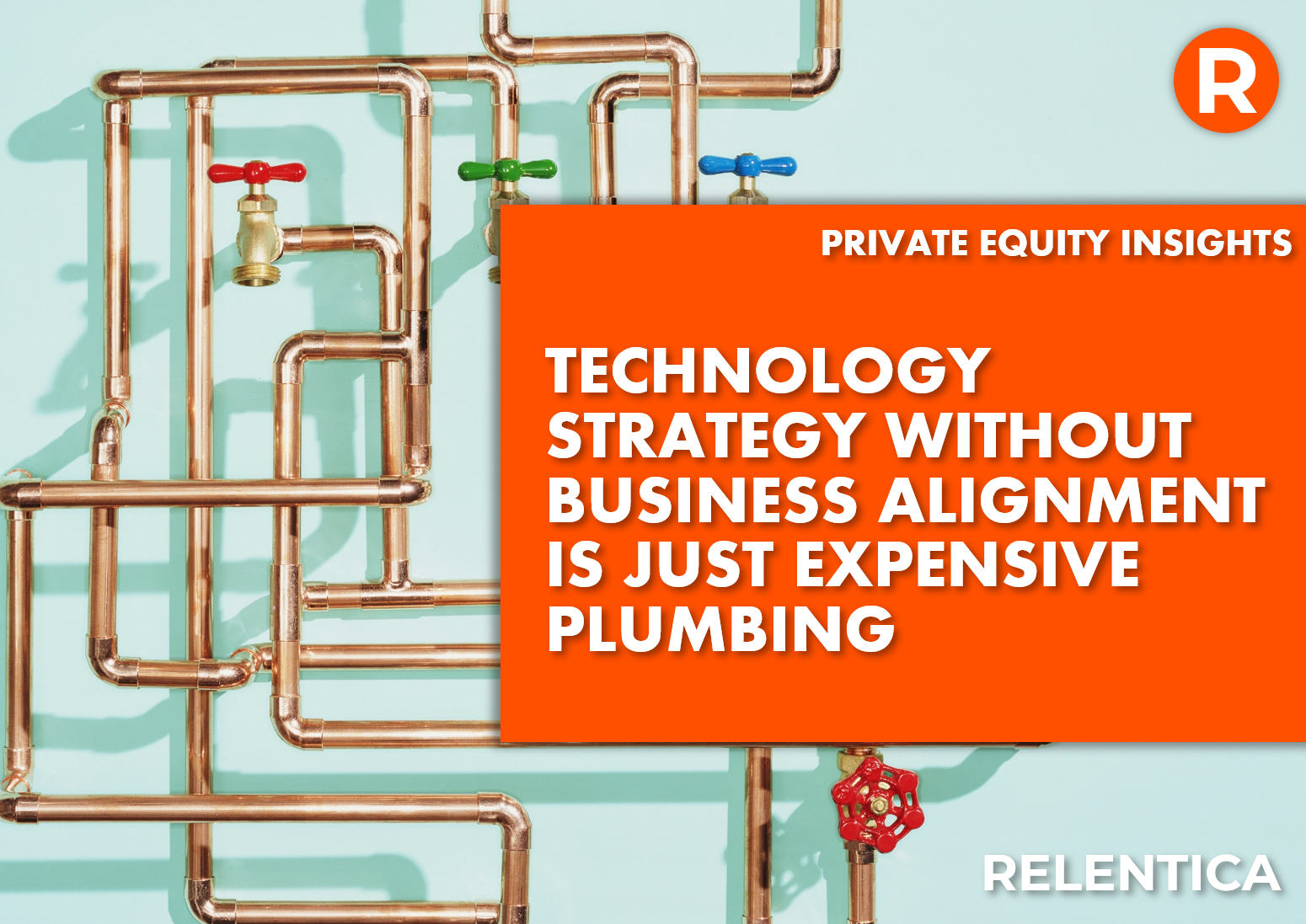
In many ways, technology and data have become the blood vessels of the organisation.
That shift becomes even more significant when AI is layered on top. Organisations now have access to intelligence at scale in ways that simply did not exist a few years ago. AI can accelerate analysis, improve decision making, simplify repetitive work and augment human capability across almost every business function.
However, AI alone does not create value.
The organisations seeing the strongest results from AI are usually not the organisations chasing the most experiments. They are the organisations with the clearest priorities, the strongest governance and the best alignment between business leadership and technology execution.
AI without direction simply accelerates chaos.
Passive strategy versus transformational strategy
There is a major difference between technology strategies that support the business and technology strategies that transform the business.
A passive strategy focuses primarily on operational continuity. Infrastructure upgrades, system maintenance, software renewals, security patching and service stability dominate the agenda. Those activities are necessary because organisations need secure and resilient operations, but on their own they rarely create competitive advantage or materially improve commercial performance.
A transformational strategy looks very different because it is built around business outcomes from the beginning.
Technology becomes part of how the organisation improves margin, accelerates delivery, simplifies operations, scales capability and creates resilience. Leadership teams use technology to reshape how the organisation operates rather than simply maintaining existing processes more efficiently.
This is also why the role of technology leadership has changed so significantly over the last decade. Modern CIOs and technology leaders cannot operate purely as technical specialists. They need to understand commercial priorities, operational delivery, organisational behaviour and execution discipline.
Technology strategy is now business strategy.
Execution rhythm is what turns strategy into results
Even strong strategies fail when organisations lose execution rhythm.
Most strategies do not collapse dramatically. They drift. Priorities change. Governance weakens. Teams become overloaded. Reporting becomes disconnected from operational reality. Delivery slows while leadership teams continue convincing themselves that progress is still happening.
Without prioritisation, everything becomes important. Without governance, decisions slow down. Without operational rhythm, momentum disappears.
This is why disciplined execution matters so much.
The organisations that consistently deliver transformation well tend to operate with strong cadence and clarity. Priorities are visible. Ownership is clear. Risks are surfaced early. Escalations happen quickly. Delivery teams understand what matters most and leadership teams stay aligned around outcomes.
Good governance should create momentum, not meetings.
Simple sounds easy when written down in strategy documents. In reality, simplicity requires discipline. Complexity is one of the biggest reasons organisations struggle to execute consistently. Too many priorities, too many disconnected systems, too many overlapping processes and too many unclear ownership lines slowly erode delivery capability over time.
The organisations that outperform are often not the most complicated or the most technologically advanced.
They are the most aligned.
Clarity, focus and disciplined execution
Technology strategy only matters when it changes business performance.
That requires more than investment in systems, platforms and AI capability. It requires continuous alignment between business priorities, technology decisions, operational capability and disciplined execution.
The organisations that succeed are rarely the ones with the biggest transformation presentations. They are the organisations capable of maintaining clarity, focus and execution rhythm over time while adapting to changing commercial pressures.
Strategy is not a yearly workshop exercise. It is the ongoing discipline of aligning the organisation behind measurable outcomes.
The best strategies are not the most ambitious.
They are the ones organisations can repeatedly execute with clarity, focus and discipline.