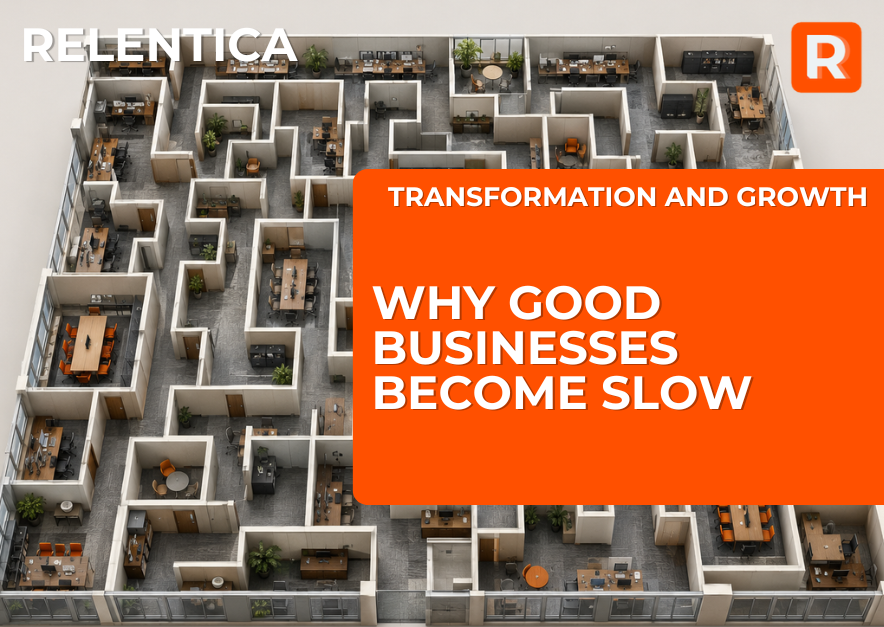
Good businesses rarely decide to become slow. It happens gradually, while leaders and teams are busy serving customers, delivering growth and managing the daily demands of the organisation.
A new product is added using an existing process. A move into another market creates a few extra approval steps. A system no longer quite meets the need, so another tool is introduced alongside it. Each decision appears reasonable in isolation, but together they create operational drag.
Eventually, work takes longer, costs rise and customers begin to notice. Employees become frustrated, reporting becomes harder and growth consumes more capacity than it creates.
Understanding why good businesses become slow is the first step towards reversing it. The answer is rarely one failed project or one poor system. It is usually the accumulated complexity that nobody has had the capacity, skills or headroom to address.
Growth should create scale, not complexity
Growth inevitably creates change, but it should not automatically create complexity. The purpose of scalable processes, operating models and technology is to allow an organisation to grow without its costs and effort increasing at the same rate.
That is how non-linear scale is created. The business serves more customers, enters new markets or introduces new products without having to replicate every role, process and system behind them.
The problem begins when growth is repeatedly bolted onto the operating model that already exists. A business diversifies, but forces the new offer through processes designed for a different product. It enters another market, but adds local workarounds rather than deciding what should become standard and what genuinely needs to differ.
Initially, the business absorbs the extra effort. Capable people work around the problems, create spreadsheets and manually move information between systems. Service continues, but the organisation is quietly spending more time and money to produce the same outcome.
The previously slick parts of the business also begin to slow. Additional steps introduced for one product or market are applied more widely. More approvals appear. Ownership becomes less clear, and decisions travel further before anybody feels confident enough to make them.
Complexity becomes normal because everyone is too close to the operation to see how much has accumulated.
How operational drag shows up
Organisational drag is not always visible in a strategy document or management report. Leaders are more likely to detect it through the experiences of employees and customers.
Work takes longer than people believe it should. Teams spend more time chasing approvals, reconciling data and resolving exceptions. Customers begin complaining about slower service or inconsistent information. Sales become harder because the business cannot respond quickly enough, configure an offer easily or provide a reliable view of delivery.
Costs rise, but not because the organisation has deliberately invested in better capability. Margin is being consumed by additional effort, duplicated work and the people needed to hold fragmented processes together.
The warning signs often include:
- Employees repeatedly expressing frustration with the same processes
- Customers reporting slower or less consistent service
- Decisions requiring more meetings, approvals or committees
- Information being rekeyed or manually reconciled
- Different teams holding conflicting versions of the same data
- Sales growth creating a disproportionate increase in operational cost
- Transformation programmes repeatedly being delayed by operational pressures
Each issue can appear manageable. Taken together, they show that the operating model is no longer supporting the organisation’s ambition.
The challenge is that these problems are often hidden by committed people. Employees create workarounds because they want to deliver. Managers add controls because they want to reduce risk. Leaders approve another system because the immediate problem needs solving.
Good intentions keep the business operating, but they can also conceal the need for deeper transformation.
Technology mirrors the way the business operates
Technology does not sit separately from business processes. It reflects and reinforces them.
Where technology does not support a process, the gap is usually filled by manual work. People transfer information, request approval by email, update spreadsheets or recreate data for reporting. The process still exists, but it is slower, harder to control and more expensive to operate.
The same pattern appears when systems that were once fit for purpose are not maintained. New features are not adopted, integrations are not improved and the platform gradually falls behind the needs of the business. Rather than addressing the underlying issue, additional systems and manual processes are built around it.
Data then becomes distributed across different platforms. Reporting requires extraction and reconciliation. Leaders struggle to create a reliable view of customers, costs or performance, making good decisions slower and more difficult.
Sometimes the original platform could have continued to support the business if it had been maintained and developed properly. In other cases, the organisation has outgrown it and needs to replace the entire system. The right answer can only be found by understanding the business process, technology architecture and commercial requirement together.
Sweating an asset can be a sensible commercial decision. Ignoring the point at which that asset begins to constrain growth is not.
The aim is not to remain years ahead of the business or continually replace technology. It is to stay just ahead of what the organisation needs, ensuring its platforms and processes support growth, control cost and maintain appropriate resilience.
That requires deliberate strategy, advisory and delivery, not technology investment for its own sake.
Simplification is an executive responsibility
The strategy for simplification belongs with the executive team. Leaders decide where the business is going, which markets it will enter and how it intends to grow. They must also ensure the operating model can support that ambition.
However, executives cannot identify organisational drag from the boardroom alone. They need to listen to the people doing the work and pay attention to frustration, context and the time it takes to achieve an outcome.
Employees often know exactly where the friction sits. They understand which approvals add no value, where information is duplicated and which systems create more work than they remove. Customers provide another important signal through complaints, delays and declining service.
The executive team must connect these experiences to commercial performance. Is technology preventing growth now? Will it prevent growth in the future? Is the problem showing up through employee frustration, customer dissatisfaction, slower sales, higher costs or declining margin?
These are not operational questions for somebody else to resolve. They are leadership questions because the answers influence investment, priorities, accountability and risk.
Simplification also requires choices. A process cannot be improved properly if every historic variation must remain. A platform cannot become authoritative if leaders continue allowing separate systems and spreadsheets to hold competing versions of the truth.
This is where experienced leadership and fractional support can create valuable headroom. An organisation may understand that something is wrong but lack the capacity or experience to step outside daily operations, diagnose the problem and lead the necessary change.
Finding where growth is being constrained
The starting point is not a new system procurement or a large transformation programme. It is a clear diagnosis of where the business is experiencing friction and why.
Leaders need to examine both the current position and the future requirement. A process might just about support today’s volumes while being completely unsuitable for the next stage of growth. A platform may appear stable because employees are compensating for its limitations through manual work.
Process mapping reveals the real flow of work, including hand-offs, delays, workarounds and duplicate activity. Technology architecture shows where systems overlap, where integrations are weak and where data is fragmented. Together, they expose the points at which effort, cost and risk are accumulating.
This creates a more useful set of questions:
- Where is technology preventing growth today?
- Where could current platforms restrict future growth?
- Which processes have become more complex without creating more value?
- Where are employees compensating for gaps in systems or ownership?
- Which customer complaints indicate a deeper operating problem?
- Where are rising costs or falling margins linked to operational friction?
- What should be simplified, maintained, automated or replaced?
The answer may be a targeted process redesign, better use of an existing platform or improved governance and ownership. It may require a broader AI, automation and digital transformation programme. In some cases, an entire process or core system genuinely needs to be replaced.
The objective is not simplification for its own sake. It is to create an operating model that allows the business to move faster, scale more effectively and remain resilient.
Complexity is a choice
Processes and systems need to be reviewed continuously, but this is difficult when operational delivery consumes every available hour. Without deliberate attention, businesses keep building on what already exists until complexity becomes a barrier to growth.
Good businesses become slow because they tolerate friction for too long. They rely on capable people to compensate, continue adding layers and postpone the decisions that would address the underlying problem.
Growth does not need to produce a slower, more expensive organisation. With the right leadership, insight and transformation, it can create greater scale, stronger margins and better customer outcomes.
Relentica helps leadership teams understand where technology and operating models are restricting performance. We map the architecture, processes and pain points, then turn that understanding into a practical strategy for simplification, transformation and growth.
If growth is creating more work than value, it is time to examine what is getting in the way.


 17 September 2026Transformation rarely fails in one dramatic moment. It slows as focus fades, communication weakens and leadership attention moves elsewhere. Protecting momentum requires clear outcomes, active sponsorship and a relentless drumbeat of visible, disciplined delivery.
 10 September 2026The best AI strategy eventually disappears. As AI becomes embedded into technology, operating models and everyday work, the real measure of maturity isn't adoption - it's whether the organisation has become a measurably better business.
 3 September 2026Technology, data and AI now shape EBITDA. For private equity investors and portfolio leaders, they influence profitable growth, operating leverage, resilience and buyer confidence throughout the investment lifecycle, from diligence through to exit.